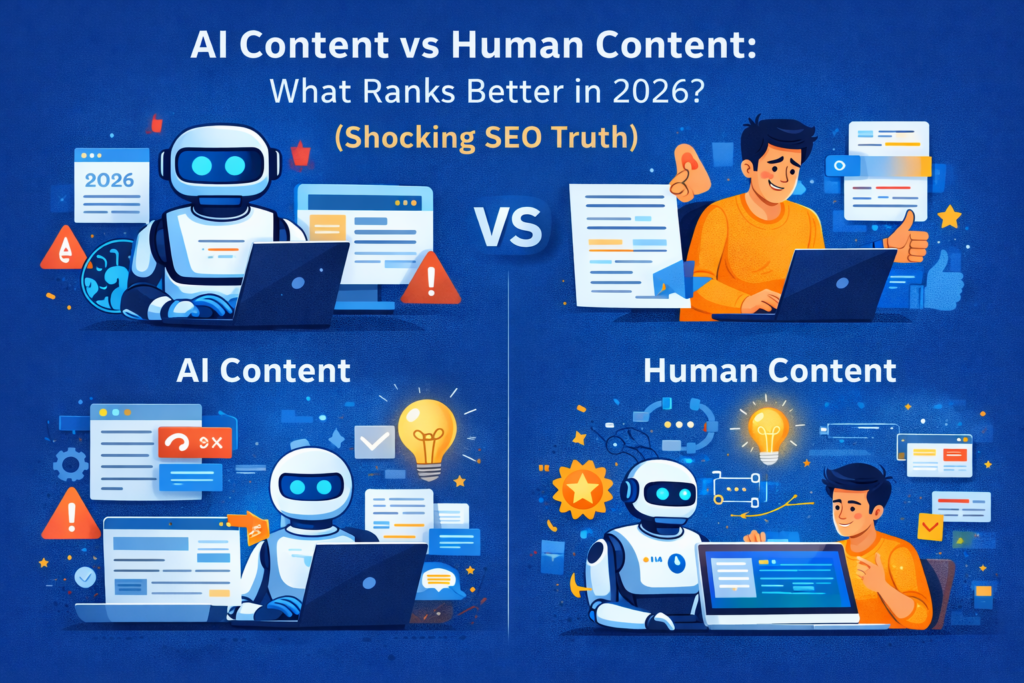
Why AI Content vs Human Content Is the Biggest SEO Debate of 2026
The debate around AI Content vs Human Content is hotter than ever. With tools like ChatGPT and other AI writers becoming mainstream, bloggers and businesses are asking one big question:
What ranks better in 2026, AI content or human-written content?
If you run a blog, online business, or SEO agency, this question directly affects your strategy, traffic, and income. Let’s break down what really works without myths or fear-based opinions.
Understanding How Google Views AI Content
First, let’s clear up a major misconception.
Google does not automatically penalise AI-generated content.
What Google actually cares about is:
- Helpful information
- Search intent satisfaction
- Experience and expertise
- Original insights
- Trustworthiness
If AI content is:
- Thin
- Repetitive
- Generic
- Written only to manipulate rankings
It will not rank.
But neither will low-quality human content.
The Strengths of AI Content in 2026
AI tools are extremely powerful when used correctly.
Speed and Efficiency
AI can:
- Generate outlines quickly
- Draft blog posts in minutes
- Suggest keyword ideas
- Help with research
For bloggers trying to scale, this saves massive time.
Data Processing Power
AI excels at:
- Summarizing large information
- Identifying patterns
- Structuring content logically
This makes it useful for:
- SEO optimization
- Content briefs
- Keyword clustering
Cost-Effective Content Production
Startups and small businesses use AI to reduce:
- Content writing costs
- Outsourcing expenses
- Time delays
However, this leads to an important challenge.
The Weaknesses of Pure AI Content
While AI is fast, it lacks:
- Personal experience
- Emotional depth
- Real-world case studies
- Unique opinions
- Authentic storytelling
In 2026, Google’s algorithms are much better at detecting:
- Surface-level content
- Reworded material
- Low-value repetition
Generic AI content often struggles to build authority.
The Strengths of Human-Written Content
Human content shines in areas AI cannot fully replicate.
Experience and EEAT Factor
Google values:
- Firsthand knowledge
- Personal examples
- Real results
- Professional background
A blogger sharing:
- Case studies
- Screenshots
- Real numbers
Will often outperform generic AI posts.
Emotional Connection
Humans understand:
- Pain points
- Frustration
- Motivation
- Tone
Content that resonates emotionally increases:
- Time on page
- Engagement
- Shares
These behavioural signals support SEO performance.
So, What Ranks Better in 2026?
Here is the honest answer.
Hybrid content wins.
The most effective strategy in the AI Content vs Human Content debate is combining both.
Use AI For:
- Research
- Drafting
- Structure
- SEO suggestions
Use Humans For:
- Editing
- Adding experience
- Personal insights
- Fact-checking
- Unique value
This approach gives you:
- Speed
- Depth
- Authority
- Authenticity
Is Google Penalising AI Content in 2026?
No. Google penalises low-quality content regardless of how it was created.
If your article:
- Answers search intent
- Provides value
- Shows expertise
- Is original
It can rank even if AI helped write it.
If it is:
- Keyword-stuffed
- Auto-published at scale
- Thin and repetitive
It will struggle.
How Bloggers Should Adapt in 2026
If you want traffic and clicks, follow this strategy:
- Use AI to speed up research and outlines
- Add personal insights
- Include examples and data
- Write naturally, not robotically
- Focus on solving real problems
Do not compete on volume. Compete on value.
SEO Strategy for AI-Assisted Content
To make AI-assisted content rank:
- Optimise for search intent
- Use semantic keywords
- Add FAQs
- Include internal links
- Keep the structure clear
- Improve readability
Google rewards content that feels useful, not automated.
Common Mistakes Bloggers Make
Avoid these errors:
- Publishing AI drafts without editing
- Not adding original insights
- Over-optimising keywords
- Ignoring EEAT
- Mass-producing thin content
FAQs: AI Content vs Human Content
Can Google detect AI-written content?
Google can detect low-quality patterns but does not automatically penalise AI use.
Should I stop using AI for blogging?
No. Use it as a tool, not a replacement for expertise.
Does human content always rank better?
Not always. Quality matters more than authorship method.
Is AI content bad for SEO?
Only if it lacks value or originality.
What is the safest approach in 2026?
Human-edited, AI-assisted content.
Will AI replace bloggers?
No. Bloggers who adapt and add value will continue to grow.
Conclusion
The debate between AI Content vs Human Content is not about choosing sides. It is about choosing the right strategy. In 2026, search engines reward value, authority, and relevance. AI is a powerful assistant, but human expertise remains irreplaceable.
If you combine AI efficiency with human creativity and experience, you will not just rank. You will build long-term authority and sustainable traffic.
Google Search Central – Guidance About AI-Generated Content
https://developers.google.com/search/blog/2023/02/google-search-and-ai-content
Even the best AI-assisted content can struggle to rank if your link profile is weak or built incorrectly, so it’s important to avoid common backlink mistakes that can kill your rankings.
Link the phrase backlink mistakes that can kill your rankings to:
https://blogwithsid.com/backlink-mistakes-that-can-kill-your-rankings